Category: TechnoAIVolution

Welcome to TechnoAIVolution – your hub for exploring the evolving relationship between artificial intelligence, technology, and humanity. From bite-sized explainers to deep dives, this space unpacks how AI is transforming the way we think, create, and live. Whether you’re a curious beginner or a tech-savvy explorer, TechnoAIVolution delivers clear, engaging content at the frontier of innovation.

  • How AI Is Powering the Smart Coffee Machines of the Future.

    How AI Is Powering the Smart Coffee Machines of the Future. #technology #nextgenai #technoaivolution
    How AI Is Powering the Smart Coffee Machines of the Future.

    How AI Is Powering the Smart Coffee Machines of the Future.

    The future isn’t just in our phones or cars anymore—it’s brewing right on your kitchen counter.

    As artificial intelligence (AI) becomes more integrated into our everyday lives, even the humble coffee machine is getting an upgrade. We’re entering a world where your morning cup isn’t just convenient—it’s intelligent. Imagine a coffee maker that learns your schedule, tracks your sleep patterns, senses your mood, and brews the perfect cup exactly when—and how—you need it.

    Welcome to the future of coffee.


    From Buttons to Brainpower: The Evolution of the Coffee Machine

    Traditional coffee machines did one thing: make coffee. Programmable ones took it a step further, letting us set timers or choose between a few brew styles. But AI-powered coffee machines? They take it to a whole new level.

    These smart appliances use machine learning algorithms and real-time data to customize the coffee experience like never before. Instead of pressing buttons, you’re interacting with a system that knows you—your preferences, your routine, and even your stress levels.

    This is more than convenience. It’s personalized, responsive automation.


    How AI Makes Your Coffee Smarter

    So how exactly does AI enhance your coffee experience?

    1. Learning Your Habits
      AI coffee machines can observe when you usually wake up, how often you drink coffee, and what type of brew you prefer. Over time, they optimize their performance to match your daily rhythm.
    2. Adapting to Your Mood
      Some advanced machines use biometric data—from wearables, smartwatches, or sleep trackers—to gauge your state. Feeling groggy? The machine may brew a stronger cup. Had a great night’s sleep? You might get a smoother, lighter roast.
    3. Voice & App Control
      Integrated with voice assistants like Alexa or Google Assistant, you can talk to your machine or schedule a brew from your phone. In some cases, AI can detect fatigue in your voice and offer to start brewing automatically.
    4. Maintenance Made Easy
      AI also tracks usage and wear, prompting cleaning, refills, or filter changes before problems arise—saving time and avoiding frustration.

    Why It Matters: AI in Everyday Life

    While a smart coffee machine might sound like a luxury, it’s part of a broader trend—AI in everyday appliances. From thermostats to fridges to vacuum cleaners, our homes are becoming intelligent ecosystems.

    Coffee is a daily ritual for millions. Making it smarter means creating a more seamless, responsive experience every day. It also raises an interesting point: when even our morning routines are being optimized by algorithms, where do we draw the line between convenience and control?


    Critics vs. Fans: Is This Genius or Overkill?

    Not everyone’s on board. Some argue this is technology going too far—do we really need a coffee machine that knows our stress levels?

    But others see it as the natural next step. If AI can save us time, reduce guesswork, and deliver a consistently perfect brew, why not? After all, we already rely on AI for music recommendations, navigation, even healthcare.

    The coffee machine is just another frontier.


    How AI Is Powering the Smart Coffee Machines of the Future.
    How AI Is Powering the Smart Coffee Machines of the Future.

    Final Sip: The Smart Brew of Tomorrow

    AI in coffee machines may seem like a novelty today, but it’s only the beginning. As tech advances, we’ll likely see more hyper-personalized appliances across every room of the house.

    Tomorrow’s coffee won’t just wake you up. It will understand you.

    So the next time your machine serves you the perfect cup without a single button press, remember: that’s not luck—that’s learning.

    And if that thought excites you—or creeps you out a bit—you’re not alone.


    Like what you’re reading?
    Check out more future-ready content at TechnoAIVolution on YouTube, where technology meets daily life in the most unexpected ways.

    #AICoffeeMachine #SmartCoffeeMaker #FutureOfCoffee #ArtificialIntelligence #SmartHomeTech #MachineLearning #SmartKitchen #HomeAutomation #TechnoAIVolution #EverydayAI #TechInnovation #AIInDailyLife

    P.S. The smartest tech isn’t always in your pocket—it might be sitting quietly on your countertop, learning your coffee habits one cup at a time. The future is brewing… and it tastes pretty damn good.

  • The Singularity? The Future Moment That Changes Everything.

    What Is the Singularity? The Future Moment That Changes Everything. #nextgenai #neuralnetworks
    What Is the Singularity? The Future Moment That Changes Everything.

    What Is the Singularity? The Future Moment That Changes Everything.

    Exploring the Rise of Superintelligent AI and the Future of Humanity

    In the world of science fiction, the idea of machines overtaking humanity is a familiar trope. But in the world of cutting-edge science and technology, it’s not just fiction anymore—it’s a real possibility known as the Technological Singularity.

    The Singularity refers to a future moment when artificial intelligence (AI) becomes so advanced that it surpasses human intelligence, leading to rapid and uncontrollable changes in society, science, and even what it means to be human. It’s not just another tech buzzword—it’s a tipping point that could redefine everything.

    So, what exactly is the Singularity? And how close are we to reaching it?


    Understanding the Technological Singularity

    The concept of the Singularity was popularized by mathematician and computer scientist Vernor Vinge, and later by futurist Ray Kurzweil. It describes a moment when AI becomes capable of recursive self-improvement—that is, when machines begin designing better versions of themselves at speeds we can’t match or predict.

    Once that threshold is crossed, technological progress could become exponential, not linear. In a matter of weeks—or even days—superintelligent AI could solve complex global problems, revolutionize industries, or… spiral beyond our control.


    What Happens at the Singularity?

    The Singularity represents a profound shift in how we interact with technology—and how technology interacts with us.

    Here are a few potential outcomes:

    • Superintelligence: Machines may become billions of times smarter than humans, capable of solving problems in medicine, energy, physics, and climate change at speeds we can’t imagine.
    • Automation of Innovation: AI could begin creating new technologies faster than humans can understand them—ushering in a new age of scientific discovery.
    • Loss of Control: If AI advances without proper safeguards, it may no longer align with human values or interests. This is often referred to as the “control problem” in AI safety circles.
    • Post-Human Civilization: Some futurists believe the Singularity could lead to transhumanism—a merging of biological and digital intelligence that blurs the line between man and machine.

    Are We Close to the Singularity?

    Estimates vary. Some researchers believe the Singularity could occur within the next few decades—Ray Kurzweil famously predicted 2045. Others are more skeptical, pointing out the current limitations in AI, such as understanding context, emotion, and abstract reasoning.

    However, the rapid progress in machine learning, neural networks, and language models (like the one you’re reading right now) has brought us closer to a world where machines can think, create, and adapt on their own.

    Even if the Singularity isn’t right around the corner, the groundwork is being laid today—and the implications are already reshaping industries and conversations around the world.


    Why the Singularity Matters

    The Singularity isn’t just a tech milestone—it’s a philosophical and existential moment. It forces us to ask big questions:

    • What happens to human identity when machines can outperform us intellectually?
    • Will AI serve us—or rule us?
    • How do we ensure ethics and safety in a world driven by self-evolving algorithms?

    Whether it leads to a golden age of human flourishing or a dystopian collapse, one thing is certain: once the Singularity hits, there’s no going back.


    What Is the Singularity? The Future Moment That Changes Everything.
    What Is the Singularity? The Future Moment That Changes Everything.

    Final Thoughts

    The idea of the Singularity can feel overwhelming—or even terrifying. But it’s also a chance to reflect on what kind of future we want to build. We’re not just passive observers. We’re the ones designing, coding, and steering the technologies that will shape tomorrow.

    As AI continues to evolve, staying informed isn’t just smart—it’s essential.

    So… what is the Singularity?
    It’s the moment when the future becomes something we can no longer predict—only prepare for.


    For more insights on artificial intelligence, emerging tech, and the edge of human evolution, follow TechnoAivolution on YouTube—where the future gets decoded.

    #Singularity #TechnologicalSingularity #ArtificialIntelligence #FutureOfAI #Superintelligence #Transhumanism #AIvsHuman #ExponentialTech #AIRevolution #TechnoAivolution #MachineLearning #DigitalFuture #PostHumanEra #RecursiveAI #FutureThinking

    P.S. The future isn’t waiting for permission. The Singularity might be closer than we think—and when it arrives, we’ll either control it… or become part of it.

  • This Is Not a Real Person: How AI Avatars Change Reality

    This Is Not a Real Person: How AI Avatars Are Changing Reality. #technology #nextgenai
    This Is Not a Real Person: How AI Avatars Are Changing Reality.

    This Is Not a Real Person: How AI Avatars Are Changing Reality.

    What if the person you’re talking to online… isn’t real?
    Not a scammer. Not anonymous. Not hiding behind a screen.
    But literally not human—an AI-generated avatar designed to look, sound, and even feel like a real person.

    Welcome to the new frontier of synthetic media, where AI avatars, deepfake technology, and digital humans are blending into our everyday lives—and reshaping how we perceive reality.


    What Are AI Avatars?

    AI avatars are computer-generated characters powered by advanced machine learning and deep neural networks. Unlike basic chatbots or animated icons, these avatars can now speak, emote, blink, and move in ways that are almost indistinguishable from real people.

    Whether it’s a customer service rep with perfect patience, a virtual influencer racking up millions of followers, or a deepfake of a celebrity saying things they never actually said—AI avatars are showing up everywhere.

    In fact, you’ve probably seen them without even realizing it.


    Where Are They Being Used?

    The applications for AI-generated humans are expanding fast:

    • Marketing & Advertising: Companies are using digital spokespeople to sell products 24/7—perfect hair, flawless delivery, and no PR scandals.
    • Entertainment: AI actors can perform endlessly, take direction without fatigue, and age backward (or not at all).
    • Customer Support: Avatars powered by AI handle queries with endless patience and growing intelligence.
    • Education & Training: Virtual tutors can adapt to different learning styles and simulate human interaction.
    • Social Media: Influencers like Lil Miquela—an entirely fictional character—have built massive followings, securing brand deals as if they were real.

    Deepfakes and Digital Ethics

    Of course, not all uses are harmless.
    Deepfake technology, which relies on similar AI tools, has raised serious concerns. Videos of public figures saying or doing things they never did can now be generated with shocking realism.

    Worse, AI avatars can be used to impersonate you.
    Your voice, your face, your mannerisms—fed into algorithms and turned into a version of you that you never created and can’t control. The line between identity and simulation is getting dangerously thin.

    As synthetic media becomes harder to detect, we’re entering a world where trust, authenticity, and even consent are being redefined.


    The Psychological Impact

    There’s also a growing psychological dimension.
    What happens when people form emotional connections with digital beings? Virtual therapists, AI companions, and even synthetic romantic partners are already being developed.

    Are we talking to a person—or just a mirror of what we want to hear?

    This shift challenges how we relate to others, and how we define what’s real in the first place.


    The Future: Are AI Avatars the New Normal?

    It’s no longer sci-fi. AI avatars are already embedded in our digital lives—and they’re only getting better. As tech continues to evolve, it’s likely we’ll see AI humans working alongside us, entertaining us, and even representing us.

    But the question we all need to ask is this:
    If something looks human, acts human, and even feels human—does it matter that it’s not?

    How do we navigate a future where reality can be generated on demand?


    This Is Not a Real Person: How AI Avatars Are Changing Reality.
    This Is Not a Real Person: How AI Avatars Are Changing Reality.

    Final Thoughts

    AI avatars are here—and they’re not going away.
    They offer incredible potential for efficiency, creativity, and innovation. But they also come with serious questions about ethics, identity, and trust in the digital age.

    We’ve crossed a threshold.
    The digital and the human are no longer separate. They’re merging.

    So the next time you see a face online, ask yourself:
    Is this a real person?


    Stay informed, stay curious, and keep questioning what’s real.
    Follow TechnoAivolution on YouTube for more insights into the future of AI, digital identity, and the evolution of human-machine interaction.

    #AIAvatars #DigitalHumans #SyntheticMedia #DeepfakeTechnology #ArtificialIntelligence #VirtualInfluencers #AIIdentity #TechnoAivolution #FutureOfAI #MachineLearning #AIvsReality #DigitalEthics #NeuralNetworks #MetaverseAvatars

    P.S. In a world where anyone—or anything—can look real, the ability to question what you see may become your most powerful tool. Stay sharp. Stay aware.

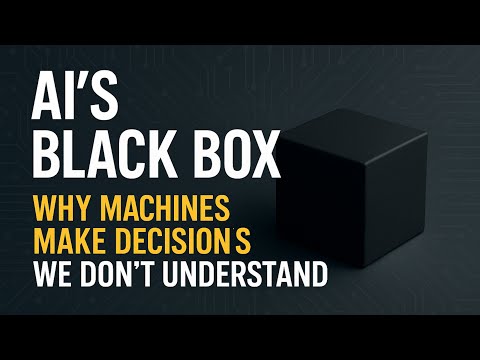
  • AI’s Black Box: Can We Trust What We Don’t Understand?

    AI’s Black Box: Why Machines Make Decisions We Don’t Understand. #ExplainableAI #BlackBoxAI #AI
    AI’s Black Box: Why Machines Make Decisions We Don’t Understand.

    AI’s Black Box: Why Machines Make Decisions We Don’t Understand.

    Artificial Intelligence is now deeply embedded in our lives. From filtering spam emails to approving loans and making medical diagnoses, AI systems are involved in countless decisions that affect real people every day. But there’s a growing problem: often, we don’t know how these AI systems arrive at their conclusions.

    This challenge is known as the Black Box Problem in AI. It’s a critical issue in machine learning and one that’s raising alarms among researchers, regulators, and the public. When an AI model behaves like a black box — giving you an answer without a clear explanation — trust and accountability become difficult, if not impossible.


    What Is AI’s Black Box?

    When we refer to “AI’s black box,” we’re talking about complex algorithms, particularly deep learning models, whose inner workings are difficult to interpret. Data goes in, and results come out — but the process in between is often invisible to humans, even the people who built the system.

    These models are typically trained on massive datasets and include millions (or billions) of parameters. They adjust and optimize themselves in ways that are mathematically valid but not human-readable. This becomes especially dangerous when the AI is making critical decisions like who qualifies for parole, how a disease is diagnosed, or what content is flagged as misinformation.


    Real-World Consequences of the Black Box Problem

    The black box problem is more than just a technical curiosity. It has real-world implications.

    In 2016, a risk assessment tool called COMPAS was used in U.S. courts to predict whether a defendant would re-offend. Judges used these AI-generated risk scores when making bail and sentencing decisions. But investigations later revealed that the algorithm was biased against Black defendants, labeling them as high-risk more frequently than white defendants — without any clear explanation.

    In healthcare, similar issues have occurred. An algorithm used to prioritize care was shown to undervalue Black patients’ needs, because it used past healthcare spending as a proxy for health — a metric influenced by decades of unequal access to care.

    These aren’t rare exceptions. They’re symptoms of a deeper issue: AI systems trained on biased data will reproduce that bias, and when we can’t see inside the black box, we may never notice — or be able to fix — what’s going wrong.


    Why Explainable AI Matters

    This is where Explainable AI (XAI) comes in. The goal of XAI is to create models that not only perform well but also provide human-understandable reasoning. In high-stakes areas like medicine, finance, and criminal justice, transparency isn’t just helpful — it’s essential.

    Some researchers advocate for inherently interpretable models, such as decision trees or rule-based systems, especially in sensitive applications. Others work on post-hoc explanation tools like SHAP, LIME, or attention maps that can provide visual or statistical clues about what influenced a decision.

    However, explainability often comes with trade-offs. Simplified models may not perform as well as black-box models. The challenge lies in finding the right balance between accuracy and accountability.


    What’s Next for AI Transparency?

    Governments and tech companies are beginning to take the black box problem more seriously. Efforts are underway to create regulations and standards for algorithmic transparency, model documentation, and AI auditing.

    As AI continues to evolve, so must our understanding of how it makes decisions and who is responsible when things go wrong.

    At the end of the day, AI shouldn’t just be smart — it should also be trustworthy.

    If we want to build a future where artificial intelligence serves everyone fairly, we need to demand more than just accuracy. We need transparency, explainability, and accountability in every layer of the system.

    AI’s Black Box: Why Machines Make Decisions We Don’t Understand.
    AI’s Black Box: Why Machines Make Decisions We Don’t Understand.

    Like this topic? Subscribe to our YouTube channel: Technoaivolution.
    And don’t forget to share your thoughts — can we really trust what we don’t understand?

    #AIsBlackBox #ExplainableAI #AITransparency #AlgorithmicBias #MachineLearning #ArtificialIntelligence #XAI #TechEthics #DeepLearning #AIAccountability

    P.S. If this post made you rethink how AI shapes your world, share it with a friend or colleague — and let’s spark a smarter conversation about AI transparency.

    Thanks for watching: AI’s Black Box: Why Machines Make Decisions We Don’t Understand.