Blog

  • Staying Present When Life Feels Like It’s Falling Apart.

    Staying Present When Life Feels Like It’s Falling Apart—Finding Peace Amid Chaos and Change.
    Staying Present When Life Feels Like It’s Falling Apart.

    Staying Present When Life Feels Like It’s Falling Apart.

    What do you do when everything around you begins to unravel?

    It’s a question most of us face sooner or later. A moment — or a season — where life feels too heavy, too uncertain, or just plain overwhelming. In those times, our natural reflex is to resist. To run. To fix. To numb. But what if the way through isn’t about escape — but presence? Staying present is not about ignoring the pain — it’s about meeting it with open eyes and a steady breath.

    Mindfulness isn’t about achieving calm. It’s about waking up.
    Not to a fantasy, but to the truth of the moment. Mindfulness is the gentle act of saying, “I’m still here,” even when life feels like it’s falling apart. Even in chaos, staying present offers a quiet kind of clarity we often overlook.

    The truth is, presence doesn’t erase pain. It doesn’t make hard things easy or sad things happy. But it does give us back our footing when we’re swept up in the storm. When thoughts pull us into regret over the past or fear about the future, mindfulness invites us to come back to the now — not because it’s perfect, but because it’s real.

    The present moment is still here. Still available. Still enough.

    When we can’t fix the chaos, we can still breathe.
    When we can’t solve the situation, we can still observe it.
    That’s power. That’s clarity. That’s what keeps us human.


    🌱 This Is a Practice, Not a Performance

    Mindfulness is not reserved for monasteries or mountaintops. It belongs in kitchens. In hospital rooms. In traffic jams. In grief. The practice of staying present becomes a lifeline when life feels like it’s spinning out of control.

    To be present when things are easy is one thing. But to stay present when you feel broken, unsure, or lost — that is sacred work. That is the true heart of emotional resilience.

    In Buddhist teachings, we’re reminded that everything changes. That impermanence is not a flaw — it’s a feature. The hardest truths are often the most liberating. Pain won’t last. Confusion won’t stay. But the breath? The body? The moment? Always here.

    One breath.
    One step.
    One choice to return.


    🕊️ Presence Creates Space — and Space Is Freedom

    Letting go doesn’t mean giving up. It means loosening your grip long enough to breathe again. That space between reaction and response? That’s where presence lives. And in that space, you are no longer a victim of your emotions — you’re an observer, a participant, a soul in process.

    Even the most chaotic moment contains a still point.
    Sometimes that still point is just a breath. A blink. A pause.

    Even in despair, you can practice kindness toward yourself.
    Even in overwhelm, you can choose to soften your gaze, release your shoulders, and come home to now.


    🌤️ You’re Not Alone — And You’re Not Broken

    If life feels like it’s crumbling beneath you, remember:
    This doesn’t define you.
    You are not your circumstances.
    You are the presence watching it all unfold.

    You’re still breathing. Still becoming.
    And even this — yes, even this — can be part of your healing.

    So when things fall apart, don’t rush to put them back together.
    Sometimes, the real wisdom lies in simply sitting with the pieces.

    Let your presence be your prayer. Let your awareness be your anchor.

    Staying Present When Life Feels Like It’s Falling Apart.
    Staying Present When Life Feels Like It’s Falling Apart.

    🌱 If this reflection speaks to you, subscribe to YourWisdomVault on YouTube for weekly videos exploring spiritual insight, mindful awareness, and emotional clarity.

    #Mindfulness #StayPresent #BuddhistWisdom #AwarenessPractice #EmotionalResilience #SpiritualGrowth #InnerPeace

    P.S. Remember, when everything feels like it’s falling apart, it’s often an invitation to pause, breathe, and return to presence. Mindfulness doesn’t fix the storm — it gives you the strength to stand inside it.

    And remember: Staying present isn’t passive — it’s a courageous act of choosing now, again and again.

  • Embeddings in AI: What They Are and Why They Matter.

    Embeddings in AI: What They Are and Why They Matter. #MachineLearning #AIEmbeddings #nextgenai
    Embeddings in AI: What They Are and Why They Matter.

    Embeddings in AI: What They Are and Why They Matter.

    How does artificial intelligence make sense of language, images, or abstract ideas?

    The answer lies in a technique known as embeddings — a way of representing complex inputs as numbers. These representations are foundational to how modern AI models interpret the world.

    From language translation to search engines and recommendation systems, this hidden layer of learning plays a major role in how AI functions behind the scenes.


    🧠 What’s the Big Idea?

    At its core, an embedding is a transformation. It takes something messy — like a word or a sentence — and turns it into a vector: a list of numbers in a multi-dimensional space.

    This might sound technical, but the concept is simple. By turning input into math, machines can compare, cluster, and relate things to one another.

    So when a computer “understands” that cat is closer in meaning to dog than car, it’s because their vectors are nearby in that space.


    🔄 How It Actually Works

    These vector-based representations are learned during training, often through large-scale neural networks. The model adjusts its internal map so that things with similar meanings or patterns end up close together — and unrelated things land far apart.

    For example:

    • “King” and “Queen” will sit close together.
    • “Apple” (the fruit) might be far from “King,” but near “Banana.”
    • The direction between “Man” and “Woman” might mirror that between “King” and “Queen.”

    It’s not true understanding — but it’s an incredibly powerful simulation of it.


    ⚙️ Why This Technique Matters

    Turning concepts into coordinates allows machines to reason about things they can’t truly comprehend. Once something has been mapped to a vector, the AI can sort, search, and even generate new content based on relationships in that space.

    Here’s where it shows up:

    • Search engines: Matching your query to content.
    • Recommendation systems: Suggesting similar items.
    • Language models: Predicting what words come next.
    • Image recognition: Linking visual features to labels.

    These systems work not because they “know” things, but because they’ve learned the structure of our language, preferences, and patterns.


    🧬 Evolution of the Concept

    Older models assigned one fixed vector to each word. That meant “bank” meant the same thing whether referring to money or a river.

    Modern models use contextual representations, generated dynamically depending on surrounding words. This has massively improved how machines handle ambiguity and nuance.

    Even further ahead are multimodal systems — which link different types of data (like text and images) into a shared space. This allows an AI to see that a photo of a dog, the sound of a bark, and the word “puppy” all point to the same concept.


    🌐 Why It’s Relevant Beyond Tech

    Even if you’re not a developer, understanding this concept helps demystify how AI interacts with our lives. Every time you use Google, Spotify, or ChatGPT, you’re indirectly using this kind of vector-based mapping.

    But there’s also a philosophical side to it. These systems are trained on human-generated data — which means they inherit our language, our categories, and even our biases.

    The way AI “represents” the world reflects how we represent it.


    Embeddings in AI: What They Are and Why They Matter.
    Embeddings in AI: What They Are and Why They Matter.

    Final Thought

    Embeddings may be invisible to the user, but they define much of what AI can do. They help machines link concepts, make predictions, and navigate meaning — even without consciousness or understanding.

    They’re not just math. They’re the glue between information and action.

    So next time AI seems like it’s reading your mind — remember, it’s not. It’s just navigating a world of vectors built on your data.


    Like insights like this?
    Subscribe to Technoaivolution on YouTube for more clear, concise breakdowns of how machines actually think.

    #AIEmbeddings #MachineLearning #ArtificialIntelligence

  • The Illusion of Progress in a World That Spins in Circles.

    The Illusion of Progress in a World That Spins in Circles, Forgetting the Stillness Within Us.
    The Illusion of Progress in a World That Spins in Circles.

    The Illusion of Progress in a World That Spins in Circles.

    In the modern world, few ideas are as sacred and unquestioned as the idea of progress. We’re told to keep moving forward. To climb higher. Achieve more. Evolve. The future, we’re promised, is where everything better awaits.

    But what if that promise is an illusion?

    From a Buddhist perspective, the notion of linear progress is deeply flawed — not just practically, but spiritually. Life, according to ancient teachings, is not a straight road that leads from ignorance to enlightenment in a predictable fashion. It’s a wheel. A cycle. A pattern repeating over and over again.

    And perhaps the more we chase progress, the more deeply entangled we become in the very cycle we’re trying to escape.


    The Wheel Keeps Turning

    At the heart of Buddhist cosmology is the concept of samsara — the endless cycle of birth, suffering, death, and rebirth. We move through lifetimes caught in attachments, desires, fears, and karmic patterns. Even in a single lifetime, we repeat smaller versions of these cycles — chasing, achieving, losing, and starting over.

    The world literally spins beneath our feet. Day becomes night, seasons rotate, generations rise and fall. Nature itself teaches us that life is circular. Yet, somewhere along the way, humanity became obsessed with the straight line — the climb, the timeline, the constant forward march.

    But does that line actually lead anywhere? Or is it just a more sophisticated way of going in circles?


    Progress vs. Presence

    Buddhism doesn’t reject the idea of growth. In fact, personal transformation is central to the path. But there’s a big difference between progress rooted in presence and mindfulness, and progress rooted in endless striving — the belief that we must become more in order to be enough.

    Modern culture sells us the latter. Do more. Be more. Have more. Upgrade constantly. There’s always a next level. But this mindset often leads to restlessness, burnout, and a nagging sense that something’s still missing — no matter how much we’ve done.

    True growth in the Buddhist sense isn’t about building upward, but about seeing clearly. It’s about waking up to the reality of the present moment. Often, the path forward is actually a path inward.


    The Trap of Linear Thinking

    Linear thinking says: “If I just do X, then Y will happen, and I’ll be happy.” But Buddhism suggests something more profound: even when you get Y, your craving won’t stop. The wheel will keep turning. Desire will simply shift to a new object.

    The more we believe we’re progressing by chasing external goals — wealth, status, knowledge, even spiritual achievement — the more we may be strengthening the very illusion that keeps us bound.

    This doesn’t mean we should give up ambition or creativity. But it does mean we should become deeply suspicious of the idea that salvation lies somewhere ahead, waiting for us to catch up.


    Stillness Is Not Failure

    One of the most radical ideas in Buddhism — and spiritual life in general — is that stillness is not stagnation. It’s insight. When we stop running, when we stop chasing, when we allow ourselves to just be, we begin to see how much of our so-called “progress” was just motion without meaning.

    Stillness creates the space to observe, to breathe, to awaken. It gives us room to step outside the wheel, even briefly, and ask the deeper question:

    Am I moving forward… or just moving?


    Reframing Progress

    So how do we reframe progress in a world that spins in circles?

    • Progress becomes awareness — not what we achieve, but what we understand.
    • Success becomes peace — not how far we get, but how present we are.
    • Growth becomes freedom — not from the world, but from the illusions that trap us within it.

    Rather than reaching for a future self, we begin to trust the wisdom of our present self. We move with the cycle, not against it. We return to what’s real, not what’s next.

    The Illusion of Progress in a World That Spins in Circles.
    The Illusion of Progress in a World That Spins in Circles.

    Conclusion: The Point Isn’t to Escape the Wheel — But to See It

    There’s beauty in cycles. The moon waxes and wanes. Flowers bloom and wither. Even our breath follows a sacred rhythm of in and out, rise and fall. Life, at its core, is not a linear sprint but a divine dance.

    The illusion of progress isn’t that we grow — we do. It’s that we think growth means leaving the present behind in search of something better. But what if what we’re searching for is already here, spinning quietly beneath our feet?

    To walk the path with wisdom is not to race toward a finish line. It’s to walk with awareness, step by step, even if the trail bends back upon itself.


    Follow YourWisdomVault on YouTube for more reflections on the hidden truths and timeless teachings behind the world’s wisdom traditions.

    #Buddhism #SpiritualWisdom #IllusionOfProgress

  • When Is Enough Truly Enough? | Buddhist Take on Contentment.

    When Is Enough Truly Enough? | Buddhist Wisdom on Contentment, Simplicity, and Inner Peace.
    When Is Enough Truly Enough? | Buddhist Wisdom on Contentment.

    When Is Enough Truly Enough? | Buddhist Wisdom on Contentment.

    In a world that constantly whispers, “just a little more,” the question becomes louder: When is enough truly enough?

    Buddhism offers a profound answer rooted not in ambition, but in awareness, contentment, and letting go. At its core, Buddhist philosophy teaches that the source of human suffering isn’t the world itself—it’s our endless desire for things to be different than they are.


    The Root of Suffering: Craving and Attachment

    One of the most famous teachings of the Buddha is this:

    “Desire is the root of suffering.”

    This truth is part of the Four Noble Truths, which form the foundation of all Buddhist thought. According to these teachings, our suffering is not caused by pain alone, but by our attachment to pleasure, our craving for permanence, and our refusal to accept change.

    We suffer because we want more—we want happiness to last forever, our possessions to stay shiny, and our lives to remain within our control. But reality doesn’t work that way. Everything changes. Everything passes. And trying to cling to impermanent things creates stress, anxiety, and disappointment.


    What Does “Enough” Really Mean?

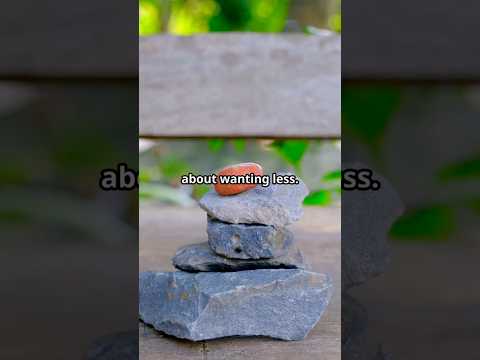
    From a Buddhist perspective, “enough” is not a number.
    It’s a state of mind.

    Contentment comes not when we have everything, but when we stop needing more to feel okay. True peace arises when we can say, “This moment is complete, just as it is.”

    This doesn’t mean giving up on goals or ambitions—it means learning to let go of the emotional craving that attaches our happiness to external things. A person can work hard, create, grow, and still be content, so long as their sense of peace isn’t based on always getting more. We rarely stop to ask when is enough, and even less often to listen.


    Why “Enough” Is Freedom

    Think of the mental energy spent chasing more:

    • More money
    • More likes
    • More attention
    • More comfort
    • More validation

    Now imagine that burden lifted. That’s what contentment feels like. It’s the freedom from needing anything to feel complete.

    This is why Buddhist monks often live simply—not because poverty is holy, but because simplicity removes distraction. When we stop feeding craving, we begin to see clearly. And from clarity comes peace.


    A Practical Takeaway: Noticing the Moment

    You don’t have to be a monk to practice this. You can begin simply by noticing:

    • When does your mind say, “I’ll be happy when…”?
    • What do you chase that never seems to satisfy?
    • What if this moment, this breath, was enough?

    The practice is not about shaming desire—it’s about observing it without letting it drive your life. Buddhism invites us to be present, aware, and grateful—not constantly pulled by the next craving. When is enough becomes a doorway to clarity, not just a question.


    A Stoic Parallel

    Interestingly, Stoic philosophy teaches something similar. Marcus Aurelius wrote:

    “Very little is needed to make a happy life; it is all within yourself.”

    Both Stoicism and Buddhism encourage us to look inward rather than outward for peace. They remind us that freedom comes not from control, but from acceptance.

    When Is Enough Truly Enough? | Buddhist Wisdom on Contentment.
    When Is Enough Truly Enough? | Buddhist Wisdom on Contentment.

    Final Reflection: What If You Already Have Enough?

    Ask yourself honestly:
    What if you already have enough?
    What changes in your heart, your pace, your sense of self, if you believe that nothing more is required for you to be whole?

    That’s not a rejection of growth—it’s the beginning of peaceful presence.


    P.S. “When Is Enough Truly Enough?” is not just a question—it’s a practice.
    👉 Want more timeless wisdom like this? Subscribe here on YouTube and unlock the vault within.

    #Buddhism #Contentment #Mindfulness #LettingGo #InnerPeace #SpiritualGrowth #YourWisdomVault