Tag: GPT-4

  • AI Didn’t Start with ChatGPT – It Started in 1950!

    AI Didn’t Start with ChatGPT… It Started in 1950 👀 #chatgpt #nextgenai #deeplearning
    AI Didn’t Start with ChatGPT – It Started in 1950!

    AI Didn’t Start with ChatGPT – It Started in 1950!

    When most people think of artificial intelligence, they imagine futuristic robots, ChatGPT, or the latest advancements in machine learning. But the history of AI stretches much further back than most realize. It didn’t start with OpenAI, Siri, or Google—it started in 1950, with a single, groundbreaking question from a man named Alan Turing: “Can machines think?”

    This question marked the beginning of a technological journey that would eventually lead to neural networks, deep learning, and the generative AI tools we use today. Let’s take a quick tour through this often-overlooked history. While many associate modern AI with ChatGPT, its roots trace all the way back to 1950.


    1950: Alan Turing and the Birth of the Idea

    Alan Turing was a British mathematician, logician, and cryptographer whose work during World War II helped crack Nazi codes. But in 1950, he shifted focus. In his paper titled “Computing Machinery and Intelligence,” Turing introduced the idea of artificial intelligence and proposed what would later be called the Turing Test—a way to evaluate whether a machine can exhibit intelligent behavior indistinguishable from a human.

    Turing’s work laid the intellectual groundwork for what we now call AI.


    1956: The Term “Artificial Intelligence” Is Born

    Just a few years later, in 1956, the term “Artificial Intelligence” was coined at the Dartmouth Conference, organized by John McCarthy, Marvin Minsky, Nathaniel Rochester, and Claude Shannon. This conference marked the official start of AI as an academic field. The attendees believed that “every aspect of learning or any other feature of intelligence can in principle be so precisely described that a machine can be made to simulate it.”

    This optimism gave rise to early AI programs that could solve logical problems and perform basic reasoning. But this initial wave of progress would soon face its first major roadblock.


    The AI Winters: 1970s and 1980s

    AI development moved slowly through the 1960s and hit serious challenges in the 1970s and again in the late 1980s. These periods, known as the AI winters, were marked by declining interest, reduced funding, and stalled progress.

    Why? Because early expectations were unrealistic. The computers of the time were simply too limited in power, and the complexity of real-world problems proved overwhelming for rule-based systems.


    Machine Learning Sparks a New Era

    In the 2000s, a new approach breathed life back into the AI field: machine learning. Instead of trying to hard-code logic and behavior, developers began training models to learn from data. This shift was powered by advances in computing, access to big data, and improved algorithms.

    From email spam filters to product recommendations, AI slowly began embedding itself into everyday digital experiences.


    2012–2016: Deep Learning Changes Everything

    The game-changing moment came in 2012 with the ImageNet Challenge. A deep neural network absolutely crushed the image recognition task, outperforming every traditional model. That event signaled the beginning of the deep learning revolution.

    AI wasn’t just working—it was outperforming humans in specific tasks.

    And then in 2016, AlphaGo, developed by DeepMind, defeated the world champion of Go—a complex strategy game long considered a final frontier for AI. The world took notice: AI was no longer theoretical or niche—it was real, and it was powerful.


    2020s: Enter Generative AI – GPT, DALL·E, and Beyond

    Fast forward to today. Generative AI tools like GPT-4, DALL·E, and Copilot are writing, coding, drawing, and creating entire projects with just a few prompts. These tools are built on decades of research and experimentation that began with the simple notion of machine intelligence.

    ChatGPT and its siblings are the result of thousands of iterations, breakthroughs in natural language processing, and the evolution of transformer-based architectures—a far cry from early rule-based systems.


    Why This Matters

    Understanding the history of AI gives context to where we are now. It reminds us that today’s tech marvels didn’t appear overnight—they were built on the foundations laid by pioneers like Turing, McCarthy, and Minsky. Each step forward required trial, error, and immense patience.

    We are now living in an era where AI isn’t just supporting our lives—it’s shaping them. From the content we consume to the way we learn, shop, and even work, artificial intelligence is woven into the fabric of modern life.


    AI Didn’t Start with ChatGPT – It Started in 1950!
    AI Didn’t Start with ChatGPT – It Started in 1950!

    Conclusion: Don’t Just Use AI—Understand It

    AI didn’t start with ChatGPT. It started with an idea—an idea that machines could think. That idea evolved through decades of slow growth, massive setbacks, and jaw-dropping breakthroughs. Now, with tools like GPT-4 and generative AI becoming mainstream, we’re only beginning to see what’s truly possible.

    If you’re curious about AI’s future, it’s worth knowing its past. The more we understand about how AI came to be, the better equipped we’ll be to use it ethically, creatively, and wisely.

    🔔 Subscribe to Technoaivolution on YouTube for bite-sized insights on AI, tech, and the future of human intelligence.

    Thanks for watching: AI Didn’t Start with ChatGPT – It Started in 1950!

    Ps: ChatGPT may be the face of AI today, but the journey began decades before its creation.

    #AIHistory #ArtificialIntelligence #AlanTuring #TuringTest #MachineLearning #DeepLearning #GPT4 #ChatGPT #GenerativeAI #NeuralNetworks #FutureOfAI #ArtificialGeneralIntelligence #OriginOfAI #EvolutionOfAI #NyksyTech
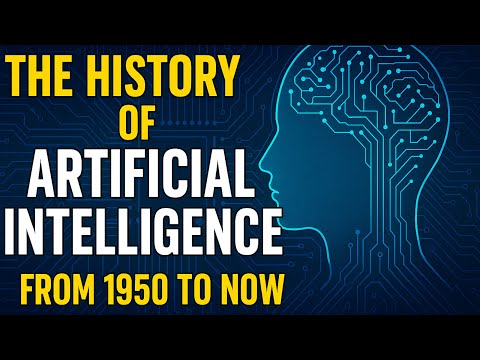
  • The History of Artificial Intelligence: From 1950 to Now

    The History of Artificial Intelligence: From 1950 to Now. #ArtificialIntelligence #AIHistory
    The History of Artificial Intelligence: From 1950 to Now — How Far We’ve Come!

    The History of Artificial Intelligence: From 1950 to Now — How Far We’ve come!

    Artificial Intelligence (AI) might seem like a modern innovation, but its story spans over 70 years. From abstract theories in the 1950s to the rise of generative models like ChatGPT and DALL·E in the 2020s, the journey of AI is a powerful testament to human curiosity, technological progress, and evolving ambition. In this article, we’ll walk through the key milestones that shaped the history of artificial intelligence—from its humble beginnings to its current role as a transformative force in nearly every industry.

    1. The Origins of Artificial Intelligence (1950s)

    The conceptual roots of AI begin in the 1950s with British mathematician Alan Turing, who asked a simple yet revolutionary question: Can machines think? His 1950 paper introduced the Turing Test, a method for determining whether a machine could exhibit human-like intelligence.

    In 1956, a group of researchers—including John McCarthy, Marvin Minsky, and Claude Shannon—gathered at the Dartmouth Conference, where the term “artificial intelligence” was officially coined. The conference launched AI as an academic field, full of optimism and grand visions for the future.

    2. Early Experiments and the First AI Winter (1960s–1970s)

    The 1960s saw the development of early AI programs like the Logic Theorist and ELIZA, a basic natural language processing system that mimicked a psychotherapist. These early successes fueled hope, but the limitations of computing power and unrealistic expectations soon caught up.

    By the 1970s, progress slowed. Funding dwindled, and the field entered its first AI winter—a period of reduced interest and investment. The technology had overpromised and underdelivered, causing skepticism from both governments and academia.

    3. The Rise (and Fall) of Expert Systems (1980s)

    AI regained momentum in the 1980s with the rise of expert systems—software designed to mimic the decision-making of human specialists. Systems like MYCIN (used for medical diagnosis) showed promise, and companies began integrating AI into business processes.

    Japan’s ambitious Fifth Generation Computer Systems Project also pumped resources into AI research, hoping to create machines capable of logic and conversation. However, expert systems were expensive, hard to scale, and not adaptable to new environments. By the late 1980s, interest declined again, ushering in the second AI winter.

    4. The Machine Learning Era (2000s)

    The early 2000s marked a major turning point. With the explosion of digital data and improved computing hardware, researchers shifted their focus from rule-based systems to machine learning. Instead of programming behavior, algorithms learned from data.

    Applications like spam filters, recommendation engines, and basic voice assistants began to emerge, bringing AI into everyday life. This quiet revolution laid the groundwork for more complex systems to come, especially in natural language processing and computer vision.

    5. The Deep Learning Breakthrough (2010s)

    In 2012, a deep neural network trained on the ImageNet dataset drastically outperformed traditional models in object recognition tasks. This marked the beginning of the deep learning revolution.

    Inspired by the brain’s structure, neural networks began outperforming humans in a variety of areas. In 2016, AlphaGo, developed by DeepMind, defeated a world champion in the game of Go—a feat once thought impossible for AI.

    These advancements powered everything from virtual assistants like Siri and Alexa to self-driving car prototypes, transforming consumer technology across the globe.

    6. Generative AI and the Present (2020s)

    Today, we live in the age of generative AI. Tools like GPT-4, DALL·E, and Copilot are not just assisting users—they’re creating content: text, images, code, and even music.

    AI is now a key player in sectors like healthcare, finance, education, and entertainment. From detecting diseases to generating personalized content, artificial intelligence is becoming deeply embedded in our digital infrastructure.

    Yet, this progress also raises critical questions: Who controls these tools? How do we ensure transparency, privacy, and fairness? The conversation around AI ethics, algorithmic bias, and responsible development is more important than ever.

    The History of Artificial Intelligence: From 1950 to Now
    The History of Artificial Intelligence: From 1950 to Now

    Conclusion: What’s Next for AI?

    The history of artificial intelligence is a story of ambition, setbacks, and astonishing breakthroughs. As we look ahead, one thing is clear: AI will continue to evolve, challenging us to rethink not just technology, but what it means to be human.

    Whether we’re designing smarter tools, confronting ethical dilemmas, or dreaming of artificial general intelligence (AGI), the journey is far from over. What began as a theoretical idea in a British lab has grown into a world-changing force—and its next chapter is being written right now.

    🔔 Subscribe to Technoaivolution on YouTube for bite-sized insights on AI, tech, and the future of human intelligence.

    #ArtificialIntelligence #AIHistory #MachineLearning #DeepLearning #NeuralNetworks #AlanTuring #ExpertSystems #GenerativeAI #GPT4 #AIEthics #FutureOfAI #ArtificialGeneralIntelligence #TechEvolution #AITimeline #NyksyTech

  • How Does ChatGPT Work? The Fastest Guide to AI You’ll Need!

    The Fastest Guide to How ChatGPT Works – AI Explained in Under a Minute! #technology #nextgenai
    How Does ChatGPT Work? The Fastest Guide to AI You’ll Need!

    How Does ChatGPT Work? The Fastest Guide to AI You’ll Ever Need

    Ever wondered how does ChatGPT work behind the scenes to generate human-like responses? Artificial Intelligence is no longer a distant sci-fi concept—it’s in your phone, your apps, your work tools… and maybe even helping you write blog posts like this one. One of the most talked-about AI tools today is ChatGPT, developed by OpenAI. But how does ChatGPT actually work?

    In this blog, we’ll break it down in simple terms—no PhD required. Whether you’re an AI newbie or just curious about the tech behind the chatbot, this is your quick and clear guide to how ChatGPT works.


    What Is ChatGPT?

    ChatGPT is a language model powered by AI. More specifically, it’s based on something called GPT, which stands for Generative Pre-trained Transformer. It’s trained to understand and generate human-like language.

    The tool was developed by OpenAI, and the version you’re using today (like GPT-4 or ChatGPT Plus) is the result of years of training, fine-tuning, and real-world interaction.

    But what’s going on under the hood? Let’s break it down.


    Trained on Text—Lots of It

    Understanding how does ChatGPT work helps demystify the power of large language models. The first thing to understand is that ChatGPT doesn’t have access to the internet while chatting with you. Instead, it was trained on a massive dataset of text from books, articles, websites, and other written sources available before a certain cutoff date.

    This training allows the AI to “learn” patterns in language. It doesn’t memorize facts like a search engine—it learns how people talk, how sentences are structured, and what types of responses typically follow certain prompts.


    Prediction, Not Thought

    Here’s the biggest myth to bust: ChatGPT doesn’t think. It doesn’t understand the world like you or I do.

    Instead, it works by predicting what word comes next in a sentence.

    Imagine you start a sentence like: “The cat sat on the…”

    Your brain knows it might end with “mat.” ChatGPT does something similar—only it’s doing it at a massive scale, using billions of parameters and a deep neural network to calculate the most likely next word, over and over, until a full response is generated.


    The Magic of Neural Networks

    So what’s powering all of this?

    Behind the scenes, ChatGPT is made up of a neural network—a kind of AI architecture inspired by the human brain. In the case of GPT-4, it has billions of connections (called parameters) that help it recognize patterns in data.

    This network allows it to understand context, tone, and structure, which is why it can sound surprisingly natural—even witty—when responding to your questions.


    It’s Not Perfect—And That’s Important

    Despite sounding smart, ChatGPT has limitations. It can “hallucinate” information (aka, make things up), misunderstand complex or vague prompts, or reflect biases found in the data it was trained on.

    Why? Because it’s not using reason—it’s using probabilities. It’s like a highly advanced guessing game, not a conscious thought process.

    That’s why OpenAI has built in safety features and moderation tools to reduce harmful or misleading content. But the tech is still evolving.


    So, How Does ChatGPT Work in a Nutshell?

    Let’s recap it fast:

    • ChatGPT is trained on a huge amount of text.
    • It learns patterns, not facts.
    • It generates responses by predicting the next word over and over.
    • It’s powered by a deep neural network with billions of parameters.
    • It doesn’t think—it mimics human-like text generation using probability.

    In short, it’s like a supercharged autocomplete system with surprisingly good conversation skills.


    Why It Matters

    Understanding how tools like ChatGPT work helps us use them more responsibly and effectively. Whether you’re a content creator, student, developer, or just curious about AI, knowing the basics can help you:

    • Write better prompts
    • Catch potential AI errors
    • Think critically about AI-generated content
    • Explore how this tech might evolve in the future
    How Does ChatGPT Work? The Fastest Guide to AI You’ll Need!
    How Does ChatGPT Work? The Fastest Guide to AI You’ll Need!

    Final Thoughts

    We’re living in an AI-powered world—and ChatGPT is just the beginning. As this technology continues to evolve, the line between machine-generated and human-created content will keep blurring.

    So next time you’re using ChatGPT, remember: it’s not magic—it’s math. And now that you know how it works, you’re ahead of the curve.

    If you found this blog helpful, see our 1-minute explainer video on the same topic for a visual breakdown, and don’t forget to like, share, and subscribe to Technoaivolution on YouTube for more AI insights. And remember! From training on massive data to predicting words—how does ChatGPT work is simpler than you think.

    #ChatGPT #AIExplained #HowChatGPTWorks #OpenAI #ArtificialIntelligence #MachineLearning #NeuralNetworks #LanguageModel #NaturalLanguageProcessing #TechnoAIVolution #AIForBeginners #AI101 #FutureOfTech #AITools #DeepLearning #SmartTech #DigitalEvolution #GPTExplained #TechExplainers

    Thanks for watching: How Does ChatGPT Work? The Fastest Guide to AI You’ll Need!