Blog

  • How AI Sees the World: Turning Reality Into Data and Numbers

    How AI Sees the World: Turning Reality Into Data and Numbers. #nextgenai #technology #chatgpt
    How AI Sees the World: Turning Reality Into Data and Numbers

    How AI Sees the World: Turning Reality Into Data and Numbers

    Understanding how AI sees the world helps us grasp its strengths and limits. Artificial Intelligence is often compared to the human brain—but the way it “sees” the world is entirely different. While we perceive with emotion, context, and experience, AI interprets the world through a different lens: data. Everything we feel, hear, and see becomes something a machine can only understand if it can be measured, calculated, and encoded.

    In this post, we’ll dive into how AI systems perceive reality—not through vision or meaning, but through numbers, patterns, and probabilities.

    Perception Without Emotion

    When we look at a sunset, we see beauty. A memory. Maybe even a feeling.
    When an AI “looks” at the same scene, it sees a grid of pixels. Each pixel has a value—color, brightness, contrast—measurable and exact. There’s no meaning. No story. Just data.

    This is the fundamental shift: AI doesn’t see what something is. It sees what it looks like mathematically. That’s how it understands the world—by breaking everything into raw components it can compute.

    Images Become Numbers: Computer Vision in Action

    Let’s say an AI is analyzing an image of a cat. To you, it’s instantly recognizable. To AI, it’s just a matrix of RGB values.
    Each pixel might look something like this:
    [Red: 128, Green: 64, Blue: 255]

    Multiply that across every pixel in the image and you get a huge array of numbers. Machine learning models process this numeric matrix, compare it with patterns they’ve learned from thousands of other images, and say, “Statistically, this is likely a cat.”

    That’s the core of computer vision—teaching machines to recognize objects by learning patterns in pixel data.

    Speech and Sound: Audio as Waveforms

    When you speak, your voice becomes a soundwave. AI converts this analog wave into digital data: peaks, troughs, frequencies, timing.

    Voice assistants like Alexa or Google Assistant don’t “hear” you like a human. They analyze waveform patterns, use natural language processing (NLP) to break your sentence into parts, and try to make sense of it mathematically.

    The result? A rough understanding—built not on meaning, but on matching patterns in massive language models.

    Words Into Vectors: Language as Numbers

    Even language, one of the most human traits, becomes data in AI’s hands.

    Large Language Models (like ChatGPT) don’t “know” words the way we do. Instead, they break language into tokens—chunks of text—and map those into multi-dimensional vectors. Each word is represented as a point in space, and the distance between points defines meaning and context.

    For example, in vector space:
    “King” – “Man” + “Woman” = “Queen”

    This isn’t logic. It’s statistical mapping of how words appear together in vast amounts of text.

    Reality as Probability

    So what does AI actually see? It doesn’t “see” at all. It calculates.
    AI lives in a world of:

    • Input data (images, audio, text)
    • Pattern recognition (learned from training sets)
    • Output predictions (based on probabilities)

    There is no intuition, no emotional weighting—just layers of math built to mimic perception. And while it may seem like AI understands, it’s really just guessing—very, very well.

    Why This Matters

    Understanding how AI sees the world is crucial as we move further into an AI-powered age. From self-driving cars to content recommendations to medical imaging, AI decisions are based on how it interprets the world numerically.

    If we treat AI like it “thinks” like us, we risk misunderstanding its strengths—and more importantly, its limits.

    How AI Sees the World: Turning Reality Into Data and Numbers
    How AI Sees the World: Turning Reality Into Data and Numbers

    Final Thoughts

    AI doesn’t see beauty. It doesn’t feel truth.
    It sees values. Probabilities. Patterns.

    And that’s exactly why it’s powerful—and why it needs to be guided with human insight, ethics, and awareness.

    If this topic blew your mind, be sure to check out our YouTube Short:
    “How AI Sees the World: Turning Reality Into Data and Numbers”
    And don’t forget to subscribe to TechnoAIVolution on YouTube for more bite-sized tech wisdom, decoded for real life.
  • How to Pause Without Guilt: Mindful Rest for Inner Peace!

    How to Pause Without Guilt — Practice Mindful Rest to Restore Balance, Clarity, and Inner Peace.
    How to Pause Without Guilt: Mindful Rest for Inner Peace!

    How to Pause Without Guilt: Mindful Rest for Inner Peace!

    In a culture obsessed with productivity and constant motion, the simple act of resting has become something we feel we must justify. We’ve been conditioned to associate stillness with laziness, and pausing with falling behind. But what if we told you that pausing—when done mindfully—is not a weakness, but a sacred form of wisdom?

    This idea is deeply rooted in both Buddhist teachings and Stoic philosophy. In both traditions, intentional rest isn’t seen as optional—it’s essential. It’s not an escape from life, but a way to return to it fully.

    The Guilt Trap of Rest

    Many of us are familiar with the voice in our heads that whispers, “You should be doing something.” Even when our body is tired, or our mind is overwhelmed, we push through. We fear being seen as unproductive or idle. This guilt-driven mindset keeps us stuck in cycles of burnout and self-judgment.

    But rest is not the opposite of effort—it’s what sustains it. Just like the inhale must follow the exhale, pausing gives life rhythm and depth. Without it, we lose our connection to presence and meaning.

    What Does Mindful Rest Look Like?

    Mindful rest is not just lying on the couch scrolling your phone. It’s the conscious decision to stop, breathe, and be with yourself without distraction.

    It could be:

    • Sitting quietly with your breath for five minutes.
    • Taking a walk without headphones, simply noticing your surroundings.
    • Saying “no” to something not aligned with your energy today.
    • A full stop—doing nothing, and being okay with it.

    Mindful rest honors the truth that you are not your productivity. You are a human being, not a human doing.

    What Buddhism Teaches About Stillness

    In Buddhism, stillness is not laziness—it’s a gateway to clarity and compassion. The Buddha himself taught the importance of right effort, which includes knowing when to act and when to pause.

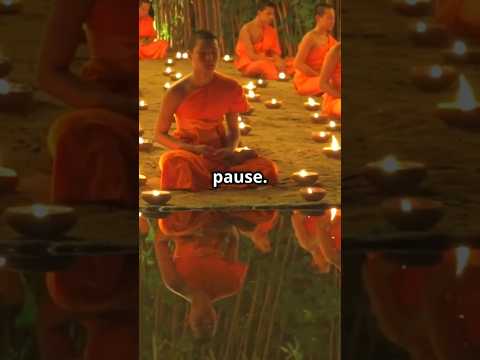
    Monastics often spend hours in seated meditation—not to escape life, but to engage with it more deeply. In those moments of silence, they cultivate presence, awareness, and inner peace.

    You don’t need to be a monk to embrace this. Even one mindful breath can create a pause in the storm.

    The Stoic Echo

    Interestingly, Stoic thinkers like Marcus Aurelius also emphasized the value of retreat. In his Meditations, he often reminded himself to “return to the self,” especially in moments of chaos or overstimulation.

    In this way, Stoicism and Buddhism meet: The still mind sees clearly. The rested soul acts wisely.

    You Are Allowed to Pause

    This is your reminder: You are allowed to rest. Without explanation. Without guilt.

    You are not falling behind by pausing. You’re showing up for yourself in the most honest way possible.

    When you choose rest with intention, you’re not stepping off the path—you’re walking it, mindfully. That pause becomes a sacred space where healing, clarity, and renewal can arise.

    A New Definition of Strength

    In a world that glorifies hustle, choosing rest is radical. It’s an act of resistance against burnout. It’s a reclaiming of your time, your energy, and your peace.

    Let’s redefine strength not as endless motion, but as the wisdom to know when to be still. In that stillness, we discover the peace that’s been waiting for us all along.

    How to Pause Without Guilt: Mindful Rest for Inner Peace!
    How to Pause Without Guilt: Mindful Rest for Inner Peace!

    If this message spoke to you, watch the 45-second video that inspired it:
    How to Pause Without Guilt: Mindful Rest for Inner Peace – available now on Your Wisdom Vault on YouTube.

    🧘‍♂️ Subscribe for more reflections on mindfulness, Buddhist wisdom, and intentional living.

  • Why AI Doesn’t Really Understand — Why That’s a Big Problem.

    Why AI Doesn’t Really Understand — And Why That’s a Big Problem. #artificialintelligence #nextgenai
    Why AI Doesn’t Really Understand — And Why That’s a Big Problem.

    Why AI Doesn’t Really Understand — And Why That’s a Big Problem.

    Artificial intelligence is moving fast—writing articles, coding apps, generating images, even simulating human conversation. But here’s the unsettling truth: AI doesn’t actually understand what it’s doing.

    That’s not a bug. It’s how today’s AI is designed. Most AI tools, especially large language models (LLMs) like ChatGPT, aren’t thinking. They’re predicting.

    Prediction, Not Comprehension

    Modern AI is powered by machine learning, specifically deep learning architectures trained on massive datasets. These models learn to recognize statistical patterns in text, and when you prompt them, they predict the most likely next word, sentence, or response based on what they’ve seen before.

    It works astonishingly well. AI can mimic expertise, generate natural-sounding language, and respond with confidence. But it doesn’t know anything. There’s no understanding—only the illusion of it.

    The AI doesn’t grasp context, intent, or meaning. It doesn’t know what a word truly represents. It has no awareness of the world, no experiences to draw from, no beliefs to guide it. It’s a mirror of human language, not a mind.

    Why That’s a Big Problem

    On the surface, this might seem harmless. After all, if it sounds intelligent, what’s the difference?

    But as AI is integrated into more critical areas—education, journalism, law, healthcare, customer support, and even politics—that lack of understanding becomes dangerous. People assume that fluency equals intelligence, and that a system that speaks well must think well.

    This false equivalence can lead to overtrust. We may rely on AI to answer complex questions, offer advice, or even make decisions—without realizing it’s just spitting out the most statistically probable response, not one based on reason or experience. Why AI doesn’t really understand goes beyond just technical limits—it’s about lacking true comprehension.

    It also means AI can confidently generate completely false or misleading content—what researchers call AI hallucinations. And it will sound convincing, because it’s designed to imitate our most authoritative tone.

    Imitation Isn’t Intelligence

    True human intelligence isn’t just about language. It’s about understanding context, drawing on memory, applying judgment, recognizing nuance, and empathizing with others. These are functions of consciousness, experience, and awareness—none of which AI possesses.

    AI doesn’t have intuition. It doesn’t weigh moral consequences. It doesn’t know if its answer will help or harm. It doesn’t care—because it can’t.

    When we mistake imitation for intelligence, we risk assigning agency and responsibility to systems that can’t hold either.

    What We Should Do

    This doesn’t mean we should abandon AI. It means we need to reframe how we view it.

    • Use AI as a tool, not a thinker.
    • Verify its outputs, especially in sensitive domains.
    • Be clear about its limitations.
    • Resist the urge to anthropomorphize machines.

    Developers, researchers, and users alike need to emphasize transparency, accountability, and ethics in how AI is built and deployed. And we must recognize that current AI—no matter how advanced—is not truly intelligent. Not yet.

    Final Thoughts

    Artificial intelligence is here to stay. Its capabilities are incredible, and its impact is undeniable. But we have to stop pretending it understands us—because it doesn’t.

    The real danger isn’t what AI can do. It’s what we think it can do.

    The more we treat predictive language as proof of intelligence, the closer we get to letting machines influence our world in ways they’re not equipped to handle.

    Let’s stay curious. Let’s stay critical. And let’s never confuse fluency with wisdom.

    Why AI Doesn’t Really Understand — And Why That’s a Big Problem.
    Why AI Doesn’t Really Understand — And Why That’s a Big Problem.

    #ArtificialIntelligence #AIUnderstanding #MachineLearning #LLM #ChatGPT #AIProblems #EthicalAI #ImitationVsIntelligence #Technoaivolution #FutureOfAI

    P.S. If this gave you something to think about, subscribe to Technoaivolution on YouTube—where we unpack the truth behind the tech shaping our future. And remember! The reason why AI doesn’t really understand is what makes its decisions unpredictable and sometimes dangerous.

    Thanks for watching: Why AI Doesn’t Really Understand — And Why That’s a Big Problem.

  • What the Buddha Knew About Anxiety Before Psychology Did.

    What the Buddha Knew About Anxiety — Ancient Wisdom That Modern Psychology Is Just Discovering.
    What the Buddha Knew About Anxiety Before Psychology Did.

    What the Buddha Knew About Anxiety Before Psychology Did.

    In our modern world, anxiety is often labeled as a psychological or neurological issue, treated with medication, therapy, and mindfulness-based practices. But what if the core of this condition was already understood thousands of years ago—by a man sitting quietly beneath a Bodhi tree?

    That man was Siddhartha Gautama, better known as the Buddha. And long before anxiety was studied in laboratories or explained in therapy sessions, he offered a surprisingly modern diagnosis of the human condition—and a profound method for healing it.

    Anxiety and the Root of Suffering

    The Buddha never used the word “anxiety” as we know it today. But he talked extensively about dukkha—a Pali word often translated as suffering, dissatisfaction, or unease. It’s the undercurrent of tension that runs through our lives, even when things seem “fine.”

    Modern psychology might define anxiety as a chronic state of fear, worry, or tension. But the Buddha explained that this suffering is deeply rooted in attachment—our craving for control, pleasure, security, and permanence in a world that is inherently uncertain and ever-changing.

    Sound familiar? That’s because it mirrors what psychologists today describe as cognitive distortions—ways of thinking that trap us in fear-based responses. Our desire to control outcomes, avoid discomfort, and resist change feeds the very anxiety we’re trying to escape.

    The Buddha’s Diagnosis: The Four Noble Truths

    At the heart of the Buddha’s teaching is a framework that almost reads like a therapeutic model:

    1. Life involves suffering (dukkha).
    2. Suffering is caused by craving and attachment.
    3. There is a way to end this suffering.
    4. The way is through the Eightfold Path.

    These teachings might sound spiritual or abstract, but they speak directly to what psychologists now confirm: trying to resist pain or force happiness leads to more suffering. Accepting reality, staying present, and letting go—these are the keys to peace of mind.

    Modern Therapy and Ancient Wisdom Align

    Fast forward to the 21st century, and we see the same principles being rediscovered. Mindfulness-based therapies like MBCT (Mindfulness-Based Cognitive Therapy) and MBSR (Mindfulness-Based Stress Reduction) teach people to observe their thoughts, detach from emotional reactions, and live in the present moment.

    CBT (Cognitive Behavioral Therapy), one of the most effective treatments for anxiety, also echoes these ancient insights: thoughts are not facts, and suffering is created by how we interpret reality—not reality itself.

    In many ways, the Buddha was the original cognitive therapist. He taught that liberation doesn’t come from changing the world, but from transforming how we relate to it.

    Letting Go: The Real Antidote to Anxiety

    Perhaps the most powerful takeaway from the Buddha’s view on anxiety is this: you don’t have to fix everything—just stop clinging.

    Letting go doesn’t mean apathy or passivity. It means releasing the mental grip on things we can’t control: outcomes, people’s opinions, the future. By loosening that grip, we give ourselves space to breathe, to respond rather than react, and to live more freely.

    It’s no wonder that modern mindfulness is rooted in Buddhist practice. The tools may have changed—apps, journals, therapy sessions—but the core wisdom remains the same.

    What the Buddha Knew About Anxiety Before Psychology Did.
    What the Buddha Knew About Anxiety Before Psychology Did.

    Final Thoughts

    So what did the Buddha know about anxiety before psychology did? Quite a lot.

    He understood that the human mind is a storm of fear, craving, and illusion—and that peace comes not from suppressing these forces, but from seeing them clearly and letting go.
    Today, science is catching up to what ancient wisdom has always known.

    If you’re struggling with anxiety, it may be worth exploring not just modern strategies, but timeless ones. The past has more to offer than we think.

    #BuddhistWisdom #MindfulnessForAnxiety #AncientPsychology #SpiritualHealing #LettingGo #MentalHealthAwareness #Dukkha #AttachmentAndSuffering #CBT #MindfulnessPractice

    P.S. If you found value in this, consider subscribing to YourWisdomVault on YouTube—more timeless insights are just a scroll away.