Blog

  • The Secret to Staying Motivated When You Feel Like Giving Up

    The Secret to Staying Motivated When You Feel Like Giving Up. #StayMotivated #MindsetMatters
    The Secret to Staying Motivated When You Feel Like Giving Up.

    The Secret to Staying Motivated When You Feel Like Giving Up.

    There comes a point in everyone’s life where motivation fades. The spark dies out, progress feels invisible, and the temptation to quit whispers louder each day. Whether you’re chasing a personal goal, building a business, developing a habit, or just trying to survive a tough season — the feeling of wanting to give up is universal.

    But here’s the truth that rarely gets said: feeling like giving up doesn’t make you weak. It makes you human.

    In this blog post, inspired by our latest video on YourWisdomVault, we explore the real reasons motivation disappears — and more importantly, how to reignite it. If you’re struggling to stay motivated, these insights and strategies can help you push forward with purpose.

    Why We Lose Motivation

    Motivation is often misunderstood. We think it’s this constant fire that should always be burning. But in reality, motivation is more like the weather — it changes.

    People often lose motivation because of:

    Burnout – Too much effort with too little rest or reward

    Overwhelm – Trying to do everything at once

    Comparison – Watching others succeed while you feel stuck

    Lack of Progress – Working hard but seeing little or no results

    Fear of Failure – Worrying that it won’t work out, so why bother?

    These are all legitimate, human experiences. Recognizing them is the first step toward shifting out of them.

    Shift From Motivation to Motion. Staying motivated isn’t about always feeling inspired—it’s about building habits that keep you going when motivation fades.

    The key to staying motivated isn’t chasing motivation — it’s creating momentum.

    Instead of waiting to feel motivated, take tiny actions. Small wins build confidence and energy. Even on your worst day, doing one thing — getting out of bed, replying to an email, going for a short walk — is progress. And progress sparks new motivation.

    Remember: You don’t need to feel motivated to take action. You just need to move.

    Reconnect With Your “Why”

    When your fuel runs out, go back to the reason you started. What are you doing this for? Who are you becoming through this process?

    Your “why” is your deeper purpose. It’s more powerful than any motivational quote. It’s personal. Emotional. Rooted in something real.

    Take a few moments to write down your why. Keep it where you can see it. Let it guide your steps when your strength feels low. One of the biggest secrets to staying motivated is reconnecting with your ‘why’ every single day.

    Create an Environment That Supports You

    Occasionally, it’s not internal struggles that block us — it’s our environment.

    Ask yourself:

    Is my space inspiring or draining?

    Are the people around me uplifting or discouraging?

    Am I consuming content that fuels or fatigues me?

    Surround yourself with reminders of your strength, your progress, and your goals. Curate your physical and digital world to support the version of you that keeps showing up.

    Let Go of Perfection

    One of the biggest motivation killers is the idea that you have to do it all perfectly. You don’t.

    Progress matters more than perfection. Consistency matters more than intensity. What you do usually matters more than what you do once in a while.

    So if today didn’t go perfectly, but you still showed up? That’s a win.

    Build Motivation Through Habits

    Motivation fades. Habits carry you through.

    Try these five motivation-boosting habits:

    Start with a 2-minute task to break inertia

    Use a “done list” instead of a to-do list to highlight progress

    Move your body daily to shift mental energy

    Limit negative input and choose content that inspires

    End your day with a win, no matter how small

    These habits build momentum and resilience — two things far more valuable than motivation alone.

    Show Up Anyway

    At the heart of motivation is this truth: the most successful, grounded, and resilient people don’t always feel like it.

    They just show up anyway.

    They write when they don’t feel like writing. They train when they’re tired. They keep going, even when the voice in their head says stop.

    Not because they’re superhuman. But because they’ve learned to trust the process.

    So today, if you’re feeling stuck, lost, or on the edge of quitting — show up anyway.

    Do the smallest thing you can. Reconnect with your why. Reclaim your focus.

    Because the secret to staying motivated… is choosing motion over perfection, purpose over pressure, and presence over performance.

    The Secret to Staying Motivated When You Feel Like Giving Up
    The Secret to Staying Motivated When You Feel Like Giving Up

    You don’t have to do it perfectly.
    You just have to keep going.

    For more weekly motivation and mindset insights, subscribe to YourWisdomVault on YouTube and join a community of growth-minded, real-world dreamers.

    You’ve got this.

    Thanks for watching: The Secret to Staying Motivated When You Feel Like Giving Up

    Ps: Whether it’s through routines, mindset shifts, or support systems, staying motivated is a skill that can be strengthened over time.

    #StayMotivated #MindsetMatters #YourWisdomVault #SelfGrowth #OvercomeBurnout #DailyDiscipline #MotivationTips #KeepGoing #MentalResilience #PersonalDevelopment
  • AI Songwriting: Can Machines Create Real Music?

    AI Songwriting: Can Machines Create Real Music? #chatgpt #nextgenai #deeplearning
    AI Songwriting: Can Machines Create Real Music?

    AI Songwriting: Can Machines Create Real Music?

    At the heart of the debate is a single question: can machines truly understand creativity? Artificial intelligence is transforming industries across the board — from finance and medicine to customer service and transportation. But one of the most intriguing and controversial frontiers is creativity. Can AI actually write a song? Not just generate sound, but create real music that carries emotional weight? As technology evolves, the line between machine output and human creativity is becoming increasingly blurry.

    The Rise of AI in Music Production

    AI is already being used in the music industry in various ways. Algorithms can now analyze popular songs, extract common structures, and generate melodies and lyrics that mimic top-charting hits. Platforms like OpenAI’s MuseNet and Google’s Magenta are pushing boundaries by creating full instrumental compositions, even in specific styles or genres. Some tools can even clone voices or master tracks with little to no human input. Today’s machines don’t just analyze music—they compose it, layer by layer.

    AI-powered songwriting tools like Amper Music, Aiva, and Soundraw allow users to create music by selecting mood, genre, and tempo. Within seconds, the AI generates a track based on those inputs. The results are often impressive — especially for background scores, ads, or royalty-free tracks — but are they truly “creative”?

    What Makes a Song “Real”?

    This leads us to a more profound question: What defines a song as “real”? Is it the structure — melody, rhythm, and harmony — or is it something less tangible? Many argue that music is about emotion, experience, and expression. When a songwriter pours heartbreak, hope, or nostalgia into lyrics, it’s not just about rhyme schemes and chord progressions — it’s about human connection. What once required human emotion and intuition is now being attempted by machines.

    AI can simulate structure. It can learn patterns. It can even write lyrics that rhyme and make sense. But can it understand heartbreak? Can it experience love? Can it feel?

    Emotion vs. Emulation

    AI-generated music typically feels impressive but hollow. That’s because while AI can replicate form, it struggles with meaning. Human songwriters write from a place of memory, pain, joy, and desire. Their music tells stories. Machines, on the other hand, rely entirely on data — no lived experiences, no inner world, no real intent.

    That said, the gap is narrowing. AI models are becoming more nuanced, more responsive, and in some cases, even more “inspired.” Recent examples of AI-generated songs have fooled listeners into thinking they were created by humans. This raises both exciting and uncomfortable questions.

    The Human-AI Collaboration

    Rather than thinking of AI as a replacement for human musicians, many experts, and artists see it as a tool — an extension of creativity. Think of it like a piano or a synthesizer. It’s not about AI taking over, but about new possibilities. Artists can use AI to experiment, generate ideas, overcome creative blocks, or build entire arrangements more efficiently.

    In this way, AI becomes a co-creator. The human still injects the soul; AI provides the scaffolding.

    Ethical and Creative Implications

    As AI becomes more prevalent in music, ethical questions arise. Who owns the rights to an AI-generated song? If a track is created with minimal human input, should the AI company receive royalties? What happens when AI starts mimicking living artists — their voices, styles, and even personas?

    There’s also the issue of originality. If AI is trained on existing music, are its compositions truly new? Or are they simply remixes of what’s already out there?

    The Future of Music Creation

    We’re at the beginning of a major shift in how music is made. AI won’t replace human creativity, but it will reshape it. As tools improve, more artists will integrate AI into their workflow. Music will evolve — perhaps not just in how it sounds, but in how it’s conceived, built, and shared.

    Imagine a future where a solo artist can write, produce, and distribute a full album in a single day — with AI assisting in every step. Or a listener who personalizes a song in real time, adjusting its lyrics or mood to fit their feelings. This isn’t science fiction. It’s on the horizon.

    AI Songwriting: Can Machines Create Real Music?
    AI Songwriting: Can Machines Create Real Music?

    Final Thoughts

    So, can machines create real music? The answer is: they can create music that sounds real. But whether that music feels real is still up for debate.

    What’s undeniable is that AI is changing the landscape of songwriting. It’s opening new doors for expression, innovation, and collaboration. And while it might not feel heartbreak or joy itself, it can be shaped by humans who do — becoming part of a creative process that’s evolving in real time.

    At Technoaivolution, we explore the fusion of technology and creativity — and this is just one example of how the future is being written… and sung.

    Welcome to the next verse in the evolution of sound.

    🔔 Subscribe to Technoaivolution on YouTube for bite-sized insights on AI, tech, and the future of human intelligence.

    Thanks for watching: AI Songwriting: Can Machines Create Real Music?

    #AISongwriting #ArtificialIntelligence #MusicTech #FutureOfMusic #AIvsCreativity #DigitalCreativity #MachineLearning #AIinMusic #SongwritingTools #Technoaivolution #CreativeAI #MusicIndustry #AIMusicGenerator #HumanVsMachine #NextGenMusic

  • Why Journaling is a Superpower: A Daily Stoic Practice.

    Why Journaling Is a Superpower — A Stoic Daily Practice for Clarity, Growth, and Inner Peace.
    Why Journaling is a Superpower: A Daily Stoic Practice for Modern Minds!

    Why Journaling is a Superpower: A Daily Stoic Practice for Modern Minds!

    In a world filled with distractions, chaos, and noise, clarity has become a rare and valuable state of mind. That’s where journaling comes in — not just as a habit, but as a true mental superpower. When practiced intentionally, journaling can unlock self-awareness, sharpen decision-making, and ground you in the present moment. The ancient Stoics knew this well, and their daily journaling practice is just as relevant today as it was 2,000 years ago.

    What Makes Journaling a Superpower?

    At its core, journaling is about seeing your thoughts. Most of us go through our days on autopilot, reacting instead of reflecting. We carry around mental clutter — unresolved worries, half-formed ideas, emotional tension — without ever really looking at it. But when you write things down, something shifts. Your thoughts become visible, your feelings become clearer, and your next steps become more intentional.

    Journaling acts as a mirror for the mind. It helps you:

    • Identify recurring thought patterns
    • Process emotions in a healthy, private way
    • Clarify goals and intentions
    • Track your growth over time
    • Make better, more conscious decisions

    In that sense, journaling isn’t just self-expression — it’s self-leadership. Why journaling works so well for Stoics is simple: it sharpens awareness and strengthens reason.

    The Stoic Approach to Journaling

    The Stoics, particularly philosophers like Marcus Aurelius and Seneca, practiced a form of daily journaling not to document their lives, but to prepare and improve their minds. Marcus Aurelius’ Meditations is essentially a personal journal filled with reflections, reminders, and mental training — never meant for public consumption. Many ask why journaling daily is worth the effort — the Stoics would argue it’s essential for self-mastery.

    Each morning, Stoics would write to:

    • Reflect on how to live wisely
    • Prepare for the challenges of the day
    • Revisit key principles (like patience, humility, and rational thinking)
    • Align their actions with their values

    And in the evening, they would review their actions and thoughts, learning from the day without judgment.

    This journaling method isn’t about perfection — it’s about progress. It’s a feedback loop for your inner world.

    Why You Should Start Journaling Today

    If you’ve ever wondered why journaling makes such a powerful difference, the answer lies in its reflection-driven clarity. You don’t need to be a philosopher to journal like a Stoic. All you need is a few quiet minutes and the willingness to be honest with yourself. You can start with a single prompt:

    • What do I want from today?
    • What thoughts keep looping in my mind?
    • How did I handle discomfort or challenge?
    • What am I avoiding — and why?

    One reason why journaling endures as a timeless tool is its ability to anchor thoughts in the present. Even five minutes a day can lead to greater self-awareness, reduced stress, and more intentional living. Over time, you’ll start to notice patterns — the way your energy rises and falls, what triggers certain emotions, and what actions consistently make you feel stronger.

    Tips for Making Journaling a Daily Habit

    Like any powerful habit, journaling requires consistency and a little structure to stick. Here are a few simple tips to help make it a part of your daily routine:

    1. Start small – Commit to just 3–5 minutes a day.
    2. Use a prompt – It reduces friction and gives your mind something to focus on.
    3. Write by hand if you can – It slows your thoughts and enhances reflection.
    4. Keep it judgment-free – Don’t worry about grammar or style. This is for you.
    5. Review occasionally – Look back weekly or monthly to spot growth and patterns.

    Journaling isn’t about being deep or profound — it’s about being real. It’s a private space where you can face yourself, gently and honestly.

    Journaling for Modern Minds

    In a digital world full of constant inputs, journaling is a chance to output. It’s the pause between stimulus and response — the breath before the leap. Whether you’re chasing personal growth, building a mindful morning routine, or simply trying to stay grounded, journaling offers a path to greater clarity and self-trust.

    It’s no surprise that successful thinkers, creators, and leaders throughout history have relied on journaling. From Leonardo da Vinci to Oprah Winfrey, from Marcus Aurelius to modern mindfulness coaches — the pen has always been a tool for power.

    Why Journaling is a Superpower: A Daily Stoic Practice.
    Why Journaling is a Superpower: A Daily Stoic Practice.

    So, if you’re feeling stuck, scattered, or just searching for a little more meaning — try journaling. Start today. Start messy. Start small. But start.

    Because once you begin to see your mind clearly… everything else starts to shift.

    Welcome to YourWisdomVault — where timeless practices meet the modern world.

    🔔 Subscribe to YourWisdomVault on YouTube for timeless insights on life, mind, and meaning.

    Remember! Why journaling? Because it turns chaotic thoughts into focused insight — a Stoic’s secret weapon.

    Thanks for watching: Why Journaling is a Superpower: A Daily Stoic Practice.

    #Journaling #Stoicism #DailyHabits #MindsetMatters #MentalClarity #SelfAwareness #PersonalDevelopment #MorningRoutine #ModernStoic #EmotionalWellness #YourWisdomVault #WriteItDown #SelfImprovement #AncientWisdom #ClarityThroughWriting #MindfulLiving #JournalingPractice #InnerGrowth #ReflectAndGrow #WisdomInPractice

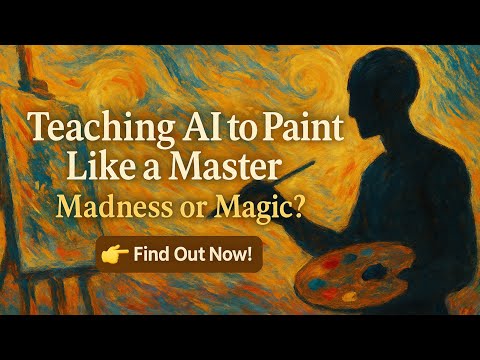
  • Teaching AI to Paint Like a Master – Madness or Magic?

    Teaching AI to Paint Like a Master – Madness or Magic? #AIArt #MachineLearning #DigitalCreativity
    Teaching AI to Paint Like a Master – Madness or Magic?

    Teaching AI to Paint Like a Master – Madness or Magic?

    In a world where artificial intelligence is composing music, writing stories, and even helping us diagnose diseases, one big question remains: Can AI truly create art? And more intriguingly—can it paint like the masters of old? In this post, we explore the fascinating intersection of AI, machine learning, and fine art, and ask: is this the dawn of a new creative renaissance or a digital descent into madness?

    The Rise of AI in the Art World

    Over the past few years, AI-generated art has exploded into the spotlight. From DALL·E creating surreal imagery from text prompts to StyleGAN generating lifelike portraits of people who don’t exist, the blend of technology and creativity is more vibrant—and controversial—than ever.

    Machine learning models are now being trained on massive datasets of paintings, illustrations, and digital media. These models don’t just copy what they see—they analyze, interpret, and generate new works based on patterns they’ve learned. That’s where things get interesting: when an AI begins to replicate the brushstroke flair of Van Gogh, the emotional depth of Picasso, or the anatomical precision of Da Vinci, are we witnessing madness or magic?

    Teaching AI to Paint – How Does It Work?

    At its core, teaching AI to paint like a master involves training neural networks using thousands—sometimes millions—of images and styles. This technique, often referred to as style transfer, allows an AI model to learn the visual language of a particular artist and apply it to new images or compositions.

    For example, a computer could take a photo of a city street and transform it into something that looks like it came straight from Impressionist France, all through the lens of Claude Monet’s painting style. It’s not just copying—it’s a computational reinterpretation.

    What makes this magical is the creative potential. What makes it controversial is the philosophical question: Is this still art? Or is it just mimicry?

    Is AI Truly Creative?

    The heart of this debate lies in what we define as creativity. Traditionalists argue that art is about emotion, intent, and the human experience—something an AI simply can’t possess. After all, can a robot feel the heartbreak that inspired a masterpiece? Can it understand beauty the way we do?

    But others argue that creativity isn’t reserved for human minds. If a machine can surprise us, provoke thought, or inspire emotion—doesn’t that qualify as art? Even more, some believe that AI might unlock new forms of expression that we haven’t even imagined yet.

    What’s certain is this: AI is changing the creative landscape. Whether you see that as an evolution or a threat depends on your perspective.

    Madness or Magic? The Artist’s Perspective.

    Many artists are beginning to embrace AI as a tool—not a replacement. Just as digital painting expanded the boundaries of traditional art, generative art tools powered by AI are becoming part of the modern creative toolkit.

    Artists now use machine learning to:

    • Generate inspiration and early sketches
    • Explore color palettes and compositions
    • Blend unexpected styles in seconds
    • Create immersive digital installations

    But with opportunity comes challenge. Some worry about AI-generated art flooding the market, devaluing human-made pieces, or leading to ethical issues around authorship and originality.

    The Future of AI and Creativity

    We’re only at the beginning of the journey. AI isn’t just copying the masters—it’s being trained to become one. And while some view that as artistic blasphemy, others see it as a leap forward into a new digital renaissance.

    In the future, we might see AI-human collaborations become the norm. Think of a world where a human sketches an idea, an AI renders it in five distinct styles, and then both refine it together. In that sense, AI could be the ultimate creative partner—not a rival.

    Teaching AI to Paint Like a Master – Madness or Magic?
    Teaching AI to Paint Like a Master – Madness or Magic?

    Final Thoughts: The Verdict Is Yours

    So, is teaching AI to paint like a master madness or magic?
    The answer may not be black or white. It might be a vibrant blend of both—painted in strokes that only a machine could dream of.

    Let us know your thoughts. Does AI art inspire you or unsettle you? Would you hang an AI-generated painting on your wall? Or do you believe the soul of art must remain human?

    🔔 Subscribe to Technoaivolution on YouTube for bite-sized insights on AI, tech, and the future of human intelligence.

    Thanks for watching: Teaching AI to Paint Like a Master – Madness or Magic?

    #AIArt #GenerativeArt #MachineLearning #CreativeAI #DigitalCreativity